
Two Types of CURED
Two types of causes, two types of illness, two types of cured.

This post is the second in a series of posts about the concept of CURED. The first post is What Means Cured?
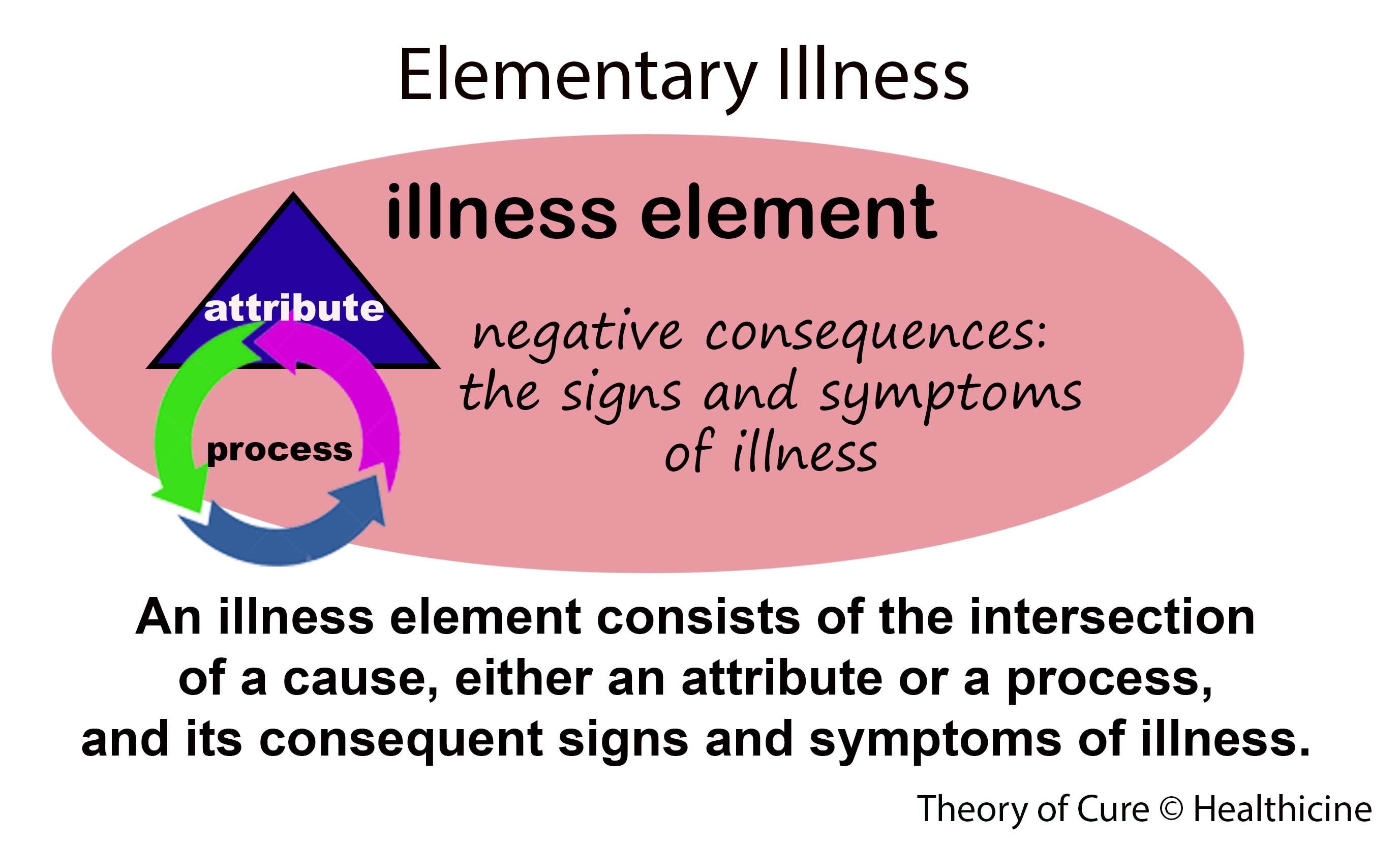
There are two fundamental types of causes of illness, as illustrated in this image.
Healthiness and Illness
Life and health consist of millions of processes and many layers of processes. Each process element can be seen as the interaction of a thing, an attribute, and an ongoing force, a process. We eat food. We breath air. If the process stops, or a faulty process starts, we can get sick. We don’t breathe water and we don’t eat poison. If those processes encounter the wrong thing - water or poison - we can get sick or die.
Cures
The cure is to address the cause. If the process encounters the wrong attribute, the cure is to remove that attribute. After we eat a poison, the most common - and most obvious cure is to vomit; to remove it from the eating process. If we are continually eating poisonous foods, the cure is to change our diet on an ongoing basis.
The cure-cause of an element of illness, or an elementary illness can be either a noun or a verb. The cause (or its absence) is present and seen as causing (not “having caused”) the illness state, such that when the cause is successfully addressed, the illness disappears.
Many illnesses, and many diseases can produce similar signs and symptoms of illness, making it difficult to find the cause. A cure proves the cause.
Acute vs Chronic
Medical practitioners often distinguish between acute and chronic diseases. These concepts are similar to attribute and process causes, but their definition is weak. An acute illness is defined as one that comes on quickly and must be quickly addressed - while a chronic illness comes on slowly - and is considered incurable. Modern medicine rarely uses the word cured and instead says that it treats diseases. Most cases of acute illness are cured. Chronic illnesses are generally defined as incurable and can only be treated.
The distinction between acute and chronic illnesses is weak, even more so when we consider cures. Their causes are easily confused.
Attribute or Chronic? For example, eating a poison can lead to an acute attack - which in most cases is cured by the simple action of vomiting. However, eating smaller amounts of the poison every day, or even every week, can cause an accumulation that creates a different illness over time. The cure is to stop eating the small amounts of the poison. The cause - the poison - looks the same, because we consider both to be a noun cause, but the second case is actually process caused and can only be cured by an ongoing negative process - stop eating the poison entirely or limit consumption to a long-term-safe level.
Chronic or Attribute? A person who wears ill fitting shoes might develop a corn on their foot. Modern medicine might treat the corn as the cause, and surgically remove it, only to find that it simply reoccurs over time. The chronic cause was not addressed. However, if the patient changes their shoes and the corn disappears, what appeared to be a chronic illness was cured by changing an attribute - the shoe.
Modern medicine does not consider an illness caused by a shoe to be a chronic illness. The theory of cure recognizes that both attribute causes and process causes can cause acute or chronic illnesses, depending on the case, proven by the cure.
Attribute Causes of Illness (nouns)
An attribute cause of illness can be the presence or absence, deficiency or excess of a thing, an attribute, or a status, such that when it is changed - the illness is cured. Examples of noun causes of illness exist in the six domains of life, health, and illness:
diet: eating a poisonous food
body: an unhealthy bodily status, like a deficiency of an essential nutrient
mind: unhealthy mental states, like depression or mania
spirits: unhealthy spirits like those of competition or cooperation
communities: abuse from our communities - family, friends, or competitors
environment: breathing unhealthy air
Sometimes, it can be difficult to identify the domain of the cause, for example:
the presence of unhealthy bacteria, fungi, and other parasites in the body or the absence of healthy parasites in the body, vs a similar presence or absence in the diet, environment, or community. The cure proves the cause.
In each case, if we can change the attribute, we can cure the illness. When the cause is an attribute, we need only eliminate that specific case of the attribute to cure that case of the illness.
Attribute Illness CURED:
Attribute caused illnesses are cured by changing the attribute cause. These are one-time cures. Once the attribute cause has been addressed, the illness is cured. If the cause occurs again, it’s a new case of illness. If we eat a poison, and vomit, the illness is cured. But that does not stop a similar illness from occurring. We cure one case of illness at a time.
Process Causes of Illness (verbs)
Process causes of illness have another dimension: time. The process cause might reoccur every hour, every day, every week, or every year - for example when winter comes. The cure is not to address the cause but to address the time dimension, the ongoing process, the ongoing time attribute of the cause.
Like attribute illnesses, examples of a process caused of illness can be found in any of the six domains of life, health, and illness:
diet: consuming a poisonous food every day, every week (chronic hangovers)
body: failure to get sufficient regular exercise or rest (weakness)
mind: obsession on specific things, while ignoring others (OCD - Obsessive Compulsive Disorder)
spirits: ongoing focus on negative thoughts (depression)
communities: helping others too much (burnout)
environments: working in a coal mine (black lung disease)
We must always be aware that some diseases can be caused by different processes in many different causal domains. For example, symptoms of depression can be caused by a faulty diet, lack of exercise or rest of body, mind, or spirits, abuse by or from our communities, or lack of sunshine in our environment. Modern medicine rarely identifies causes of depression - except in cases like SAD - Seasonal Affective Disorder, where the cure proves the cause to be an absence of sunlight. Even when the cause is identified, SAD is considered to be incurable in medical practice, because the disease might re-occur next winter. In the theory of cure, if case is cured - with a special lamp for example, and the cure is removed, a new case of illness might occur.
Process Illness CURED:
Process caused illnesses are cured by changing temporal attribute of the process cause. These are ongoing cures. Once the process cause has been addressed, the illness is cured. But the new process must be maintained.
Every Cured
Every case of cured can be classified as a one-time cure, an attribute cure, or as an ongoing process cure. The cure proves the cause.
In the case of a cured attribute illness, a new case of illness might occur if the cause - the presence or absence of the causal attribute occurs again. Most attribute causes of illness don’t cause illness every time.
In the case of a cured process illness, a new case of illness might occur if the cause - the presence or absence of the causal process occurs again, or if the new curative process fails or becomes absent. Most process causes of illness don’t cause illness most of the time.
Compound Illnesses
A compound illness has multiple causes creating the same signs and symptoms such that the illness is only cured, the signs and symptoms on stop occurring, when each cause has been successfully addressed. If addressing a single cause produces a cure, the illness was elementary.
A compound illness might have both types of causes - attribute and process causes, such that two or more curative actions are required.
For example: A case of severe depression might be caused by a faulty diet, leading to a body depleted of exercise and rest, a mind that is constantly worried. The patient’s family might become abusive, increasing the depression. As a result, changing the dietary cause might slowly result in a complete cure - but only if all the other causes are changed. Many doctors who cure (as opposed to just treating) depression use a shotgun approach - addressing possible causes in each of the six domains of healthiness, and when a cure occurs - they have no need to be preoccupied with the cause of the cure.
Complex Illness
A complex illness is present when one element of illness causes another element of illness.
Most cases of disease are complex illnesses, simply because most elementary illnesses are easily cured. If we have a minor bruise, cut, indigestion, a minor case of the common cold, flu, or COVID, we don’t visit a doctor. If a cut gets infected, a secondary illness caused by the cut, we may need to visit a doctor. If the cold or flu persists it might develop into the disease pneumonia. Some references, for example, claim that the common cold is not a disease.
Complex illnesses require a cure for both the primary and the secondary illness. Both the cut and the infection need to be cured.
In many cases, if the primary illness is cured, the secondary illness is cured by healing. A patient suffering from scurvy, a deficiency of Vitamin C, might suffer many minor injuries which are cured when the deficiency is addressed.
The Two Cureds
Every curable elementary illness, every curable element of illness can be identified as caused by the absence, presence, deficiency, or excess of an attribute or process cause in one of the domains of diet, body, mind, spirits, communities, or environments.
The cure is to address the cause. The cured case proves the cause.
Proof?
Of course we might be wrong in any individual case. Individual life forms are constantly living, eating, growing, dying, exercising their bodies, minds, spirits, interacting in their communities and environments - until they die.
Most cases of illness are easily cured without conscious intention, without conscious attention. We might never be certain about the cause - even if we can reproduce the illness. But, to cure and to learn how to cure more effectively, we must study cases of CURED.
to your health, tracy
Author: A New Theory of Cure